Contrasts in Revelation
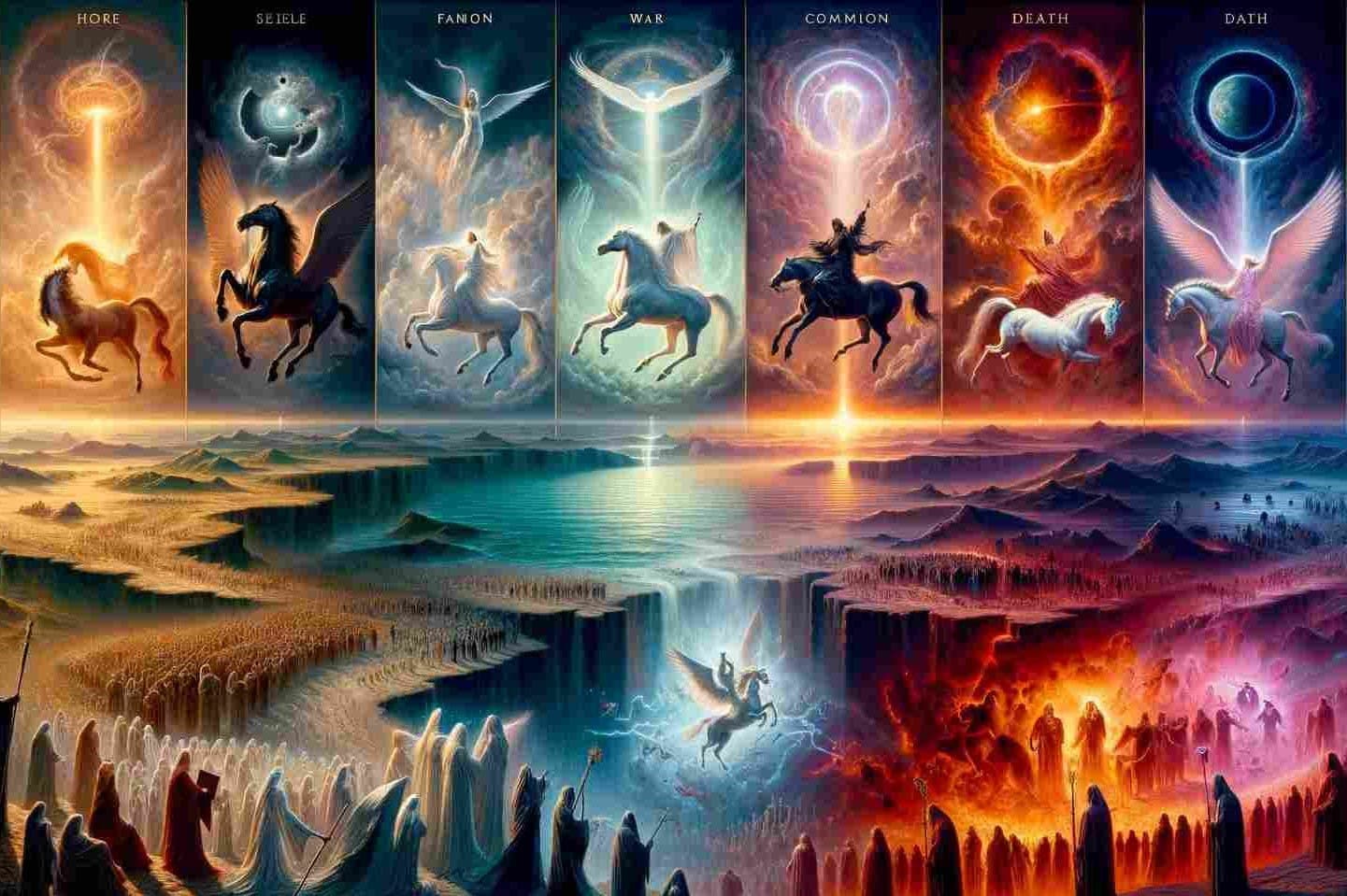
Revelation: The Book of Contrasts
Here are 18 contrasts from Revelation, some essential, some less significant (you decide).
-
Truth vs. Deception. (good vs. evil) The whole of Revelation is the description of the new covenant battle between God’s plans and the destroyer of all good (and his methods). The gospel going forth is God’s plan and focus. In John’s gospel (14:6) Jesus claimed to be the way, the truth and the life. In Revelation, Jesus calls Himself “He that is true” in 3:7 and “The faithful and true witness” in 3:14. The saints call Jesus “Lord, holy and true” in 6:10 and an angel from the altar proclaims, “Your judgements are true and righteous” and a great multitude in heaven (19:2) repeated how God’s judgements are true and righteous. Jesus’ name is “Faithful and True” as He judges and makes war in 19:11. We are on the side of Truth, and Righteousness. Chapters 12 and 13 give us a clear picture of what the entire church age is facing. In chapter 12, The dragon (identified for us) can’t stop the birth or the life and ministry of Jesus (God’s Messiah, Savior, Healer, Redeemer). Instead, he settles for making war with “the remnant of her seed which keep the commandments of God and have the testimony of Jesus Christ” (that would be us). Chapter 13 reveals how that is done under the symbolism of two beasts. The first ten verses describe a familiar image from Daniel which is government power opposed to God’s will (the saints overcome with patience and faith v.10). The next 8 verses describe the second ‘beast’ made up of false and misleading philosophies and religions. The first subjugates the body, the second manipulates mind. 18:23 says “All nations were deceived”, In 19:20 we read about the false prophet that wrought miracles by which he “deceived all who had received the mark and worshipped the beast’s image”. In 19:2 “the harlot corrupted the earth”, and 20:10 confirms “the devil deceived them”. The “god of this world” (2Cor.4:4) controls government, religion, education and entertainment. 1John 5:19 says “The whole world lies in wickedness”. This is a confirmation of Ephesians 6:12 which states “We wrestle not against flesh and blood but powers, rulers of darkness…etc.” Our enemy is not people, but deception. It stands to reason then, “The weapons of our warfare are not carnal but strong, through God to pulling down strongholds” (2Cor.10:4), Spiritual warfare! We ‘fight’ with truth. Truth isn’t static, truth is dynamic. Truth rides forth conquering 6:2. Truth walks amidst the churches holding up pastors 1:20. Truth is a sword, that living, powerful Word of God that defeats darkness 16:10. Truth overcomes through gospel testimony 12:11, and in the end, Truth triumphs over everything opposed to God’s plan. 21:27. How does it end? Chapter 20 reveals that the dragon is not allowed to create a deception that affects the whole earth until the end of the church age (20:1-7). When the gospel has completed its mission, all those whose names that are in the Lamb’s book of life are secure (sealed), then, the “world” will come together under the last universal deception against the church. The ‘end’ is depicted in chapters 16, as Armageddon, chapter 19, as the Whitehorse rider vs. beast, and chapter 20, as gog and magog vs. camp of saints. Three symbolic battles under the same term, “the battle” (‘ton polemon’ in Greek) where the world, gathered by its leaders, battles Jesus and the saints. [The same deception mentioned by Paul in 2Thess.2:3 and Jesus in Matt.24:12-13]. Just a hint, it doesn’t go well for the deceived!
-
The Tale of Two Cities. Jerusalem vs. Babylon. Jerusalem (used 3 times), called new Jerusalem and the holy Jerusalem is contrasted to Babylon (used 6 times). From the earliest days, Salem and Babel represented the best and worst in men. Jeru (foundations) Shalom (peace) ‘foundations of peace’ represented by Melchizedek (King of Salem), David, and later Jesus Christ reflected shepherd warrior kings who “lay down their lives for the good of the sheep”. Verses Babel (confusion) represented by Nimrod, a mighty hunter with a “gratify yourself at the expense of your victim” mentality. The city of God is called New Jerusalem in Rev.3:12, and 21:2&10. Jesus stands on Mt. Zion in 14:1. Babylon (1st mentioned in 14:8) is also called “the great city” nine times and “the harlot” in chapter 17. The Revelation overall is a treatise on good versus evil and how in the end, God’s will is fully accomplished and all who submitted to His will and purpose received abundantly more than they expected, and all who opposed Him get abundantly more than they expected.
-
The Bride vs. ‘the other woman’. The church is called the bride of Christ four times in the Revelation. Chapter 19 talks about the marriage of the Lamb and how the wife has made herself ready. Arrayed in fine linen, which is the righteousness of the saints. And blessed are they that are called to the marriage supper of the Lamb. In contrast is the harlot wearing scarlet, riding on the beast and drinking from a gold cup full of abominations and the filthiness of her fornications, drunk with the blood of the saints and martyrs of Jesus. This type of contrast is expressing in a deafening roar “There is no middle ground”! Friends of the world are the enemies of God (James4:4). There is a third “woman” in the letter. In 12:1-2, this woman obviously represents Israel “giving birth” to Messiah.
-
Good Blood vs. Bad Blood. The word blood is used 19 times. Blood that brings life: 1:5 Jesus Christ washed us from our sins in His own blood. 5:9 Worthy…redeemed us to God by your blood. 12:11 They overcame by the blood of the Lamb. 19:13 Jesus clothed in a vesture dipped in blood. Blood that brings death: 6:12 The moon became blood. 8:7 Hail and fire mingled with blood kill 1/3 trees and all grass. 8:8 1/3 sea became blood. 11:6 witnesses have power to turn water to blood and smite the earth. 16:3 The sea became blood and every living thing died. 16:4 Rivers and fountains became blood. Saint’s blood: 6:10 How long…till you avenge our blood? 16:6 They have shed the blood of the saints and prophets (therefore God gave them blood to drink). 17:6 woman drunk with the blood of the saints and martyrs of Jesus. 18:24 In her was found the blood of the prophets and saints. 19:2 He has avenged the blood of His servants. Sinners blood: 14:20 Blood came out of the winepress.
-
Good Angels vs. Bad Angels. The word Angel/Angels is used 76 times in Revelation. The word angel is a transliteration from Greek “angelos” meaning messenger. The good angels are prevalent and show up in all but four chapters. The bad angels only show up in chapters 9:11 and 12:7-9.
A few controversial questions arise in Revelation including:
- Is Jesus ever called (or can He be called) an angel in Revelation?
- The letters to the seven churches are addressed to “The angel of the church of…” Did Jesus send them to angels or pastors? (pastors can be messengers)
- The angel that shows John the bride (21:9), claims he is a “fellow servant and of John’s brothers the prophets” (22:9)!
-
The Seal vs. The Mark. The saints are sealed with the seal of the Living God in 7:1-4. When the fifth trumpet sounds, the locusts could only hurt those who didn’t have the seal of God on their foreheads (9:4). In contrast are those who take the mark (notice God gives the seal, men take the mark). The beast out of the earth compels men to take the mark through deception (13:16-17, 19:20). Taking the mark destined them for judgement (14:11, 16:2).
-
True worship vs. beast worship. The word worship is used 15 times in Revelation. It means ‘to bow down, prostrate oneself, show deep reverence, adore or submit to a higher authority. We find The 24 ‘falling down’ in worship at the throne in 4:10, and the admonition to “Worship God” in 14:7 and fear God and give Him glory. Then again in 15:4 “You are holy, all nations will worship you”. And lastly in 22:9 “Worship God”! Interestingly, John is given a reed to ‘measure the worshippers’ in 11:1. In contrast, the world has its object of worship. Worship the beast! “All that dwell on the earth whose names are not written in the book of life of the Lamb slain from the foundation of the world” (13:8). In 9:20 they worship devils and idols. In 13:12-15 the world is deceived into worshipping the beast whose deadly wound was healed. An angel proclaims in 14:9-11 worshipping the beast results in eternal torment.
-
True prophets vs. false prophet. God had declared the mysteries of God through His prophets (10:7). He is called “The Lord God of the holy prophets” in 22:6. The mighty angel told John he must prophecy before many peoples, nations, tongues and kings. The two witnesses are called prophets in 11:10. They have freedom to proclaim the gospel without resistance during the church age. At the second coming the servants and prophets are rewarded (11:18) and those who killed God’s prophets receive judgement. This judgement is confirmed in 18:20-24. The false prophet is described in 16:13 as being a mouthpiece for deception. His demise is described in 19:20 and 20:10.
-
The True Lamb vs. the fake lamb. When the scroll is presented in chapter 5, the question is proclaimed “Who is worthy to open the scroll?” John hears the answer “The Lion of the tribe of Judah” then sees a Lamb. As the Lamb takes the scroll, those around the throne (10,000x10,000+) sing Blessing and Honor and Glory and Power be unto Him forever. The Lamb is instrumental throughout the letter and is mentioned 24 more times! The fake lamb is the beast out of the earth in 13:11. He had two horns like a lamb but didn’t speak like one. This is a counterfeit Christ.
-
God’s wrath vs. dragon wrath. Wrath is used 13 times in Revelation. This word means anger, indignation, a fixed, passionate feeling against something. The dragon exhibits great wrath because he has been cast down to the earth knowing his time is about over (12:9). God’s wrath is mentioned several times. The divisions of the book of Revelation can be clearly seen if you understand that God’s wrath is preserved to be poured at the end of the age. “Hide us from the wrath of the Lamb” 6:16. “The great day of His wrath has come” 6:17. “We give thanks to God Almighty …your wrath has come” 11:18. “The same shall drink of the wine of the wrath of God” 14:10. “The angel gathered the vine of the earth and cast it into the great winepress of the wrath of God”. 14:19. “The great city was divided…and God gave her the cup of the wine of the fierceness of His wrath 16:19. “He treads the winepress of the fierceness and wrath of Almighty God” 19:15. Then there are these two verses: 14:8 announcing Babylon is fallen “because she made all nations drink of the wine of the wrath of her fornication”. And 18:3. “For all nations have drunk of the wine of the wrath of her fornication, and the kings of the earth have committed fornication with her, and merchants of the earth are waxed rich through the abundance of her delicacies” (a little less clear).
-
Heads, Horns and Crowns. Heads: The word head/heads is used 19 times in Revelation. Most every image throughout the book has one head. The two exceptions have seven. One in 12:3, the great fiery dragon and the beast out of the sea in 13:1 and 17:3-10. The dragon image is explained as the devil and satan the accuser, our main enemy going about his main job. These seven heads have been variously interpreted but show universal authority, worldwide influence over all aspects of non-Christian life. The main lesson to see is he has a vast array of tools (this is the “flood” the serpent cast out after the woman 12:15. The earth helped the woman and swallowed up the flood 12:16) [in my opinion]. The seven heads of the beast are mentioned four times and are interpreted for us in 17:9. “The seven heads are seven mountains”. This could be the literal interpretation and would signify Rome or Jerusalem, or mountain could be another symbol and depict a “prominent seat of power”. The context should help. Horns: The word horns is used 10 times. Four images have horns. The Lamb, the dragon, the beast out of the sea and the beast out of the earth. Horns indicate power and authority. The Lamb has 7 horns (5:6). This usually suggests omnipotence. All power and all authority. The fake lamb has two horns made to imitate a lamb (mild and gentle). The dragon and the beast out of the sea both have ten horns (political and military power). In Revelation, the horns on the beast are interpreted as ten kings (17:12). In Daniel’s vision of the statue (Dan.7:7-24) the fourth beast has ten horns (7:7) and they are also interpreted as ten kings. Crowns: The words crown/crowns are used 11 times. There are two words for crown used in the letter. Stephanos is a victor’s crown, and diadem is a royal crown. Gold crowns are rare. Jesus wears a golden stephanos in 14:14. The 24 elders wear gold stephanos in 4:4 and 4:10 (the only gold crowns). The woman in 12:1-2 wears a stephanos with 12 stars, the white horse rider goes out given a stephanos, and the saints are offered a stephanos in 2:10 and cautioned about their stephanos in 3:11. There is an odd description of the locust in 9:7 saying they are wearing “something like gold stephanos”. Three entities wear diadems. The dragon wears 7 diadems (12:3), the beast out of the sea wears 10 diadems, and Jesus wears many diadems (19:12) interestingly none gold (the words gold/golden are used 22 times in the letter but not for the diadems).
-
Fire from Heaven. This imagery symbolizes power and authority. The angel in 8:5 takes a censer filled with fire off the altar and casts it to earth. Also in 8:7 hail and fire mixed with blood are cast to the earth. At the last battle, God sends down fire from heaven to destroy satan, gog and magog fighting against “the camp of the saints and the beloved city” in 20:9. Interestingly, the false prophet can show this great sign as well. He is able to “make fire come down from heaven” as a deceptive miracle to influence men to take the mark (13:13).
-
White horses vs. all the other horses. The word horse/horses is used 15 times in Revelation. As the Lamb opens the first four seals on the scroll in chapter 6, One of the living ones says “Come”, and a horse appears, white, red, black then pale (ashen). These appear to represent outcomes or consequences of the scroll being opened. The white horse returns (in 19:11-21) with “Faithful and True” sitting upon it with the armies of heaven following on white horses of their own. These confront the beast, the kings of the earth, and their armies (on horses also 19:18?). The white horse riders are quickly and completely victorious (19:20-21). The word horses also appears in 9:7-9 where the 5th angel has sounded, a star falls from heaven, the bottomless pit is opened and locusts in the shape of horses prepared for battle come out…sounding like horses running to battle. Again, as the 6 th angel sounds 200 million horsemen are loosed. The heads of the horses were like lions and their tails like serpents (9:17-19).
-
Seas, waters, rivers and fountains. The Revelation uses “sea” 26 times. The “sea of glass” like crystal before the throne in heaven mentioned in 4:6 and 15:2 is contrasted to the sea on earth (and its creatures) 5:13, 8:9, 12:12. This sea isn’t hurt until the saints are sealed (7:2-3), after which, a burning mountain is cast in (8:8-9). The mighty angel plants his right foot into the sea when proclaiming his message (10:2-6), and the beast is seen coming out of the sea in 13:1. Later, everything in the sea dies (16:3), and the sea gives up the dead in 20:13. Waters are contrasted as well. Water/waters are used 18 times. Jesus leads us to living fountains of waters (7:17) which are offered to all (21:6, 22:1,7), however, the serpent casts out water as a flood in 12:15, the 3rd angel pours out wrath on the fountains of waters in 16:4 and the Euphrates water dries up (16:12). The waters that the harlot sit on (17:1) are interpreted for us in 17:15. “The waters you saw are peoples, multitudes, nations and tongues”. Rivers are also contrasted. Used 6 times, the Pure ‘river’ of the Water of Life (22:1-2) is contrasted with the great river Euphrates (9:14, 16:12). Rivers are also mentioned in the judgements in 8:10 and 16:4. Fountains (springs), used 5 times, are always mentioned with ‘water’. The Lamb leads us to fountains of waters (7:17, 21:6), “Worship the Creator of the fountains of waters” (14:7), but the star falls into the fountains of waters and they become blood (8:10) see also 16:4.
-
Great Mountain vs. great mountain. At the sound of the second angel (8:8), “As it were a great mountain, burning with fire was cast into the sea”. This reads much like Jer.51:25 where God calls Babylon a destroying mountain which He will roll down and burn. In 21:10 John is carried away in the spirit to a “great and high mountain” to see the holy Jerusalem.
-
Little Season. The little season is mentioned twice. Once in answer to the souls who had been martyred, “You must wait a little season until the number of martyrs is fulfilled”. The other mention is in chapter 20 when the dragon is loosed for a little season to do the one thing he had been restricted from doing during the church age, that is to deceive the nations.
-
Come, I will show you… In 17:1, “One of the angels that had the seven vials” invites John to “Come, I will show you…the great harlot”, “and he carried me away in the spirit”… In 21:9, “One of the angels that had the seven vials” invites John “Come, I will show you… the bride”, “and he carried me away in the spirit” and showed me the great city. Interestingly the two images John is ‘flown away’ to see are the two women, both described as ‘great’. The descriptions of the harlot go on for sixteen verses and the bride for seventeen verses.
-
Lamps Burning. “There were seven lamps #2985 of fire burning #2545 before the throne” (4:5). In 8:10, A star falls from heaven burning #2545 like a lamp (torch) #2985. The seven lamps burning before the throne are called “the seven Spirits of God” also mentioned in 1:4 and 5:6. Imagery of the Holy Spirit in His manifold perfections. The falling star imagery in 8:10 is likely related to the falling stars in 12:4 as the rivers become bitter from wormwood (see Lamentations 3:15).